Capital Gains Tax on a Home Sale in Bakersfield: 2026 Guide

Many Bakersfield homeowners can exclude some or all of the gain when they sell the home they live in. If you owned the home and lived in it for at least two of the last five years, the IRS lets you exclude up to $250,000 of gain, or $500,000 for a married couple filing jointly, and California follows the same exclusion. Tax usually shows up on rentals, second homes, short stays, depreciation from a home office or rental use, and very large gains.
The featured image on this post is an illustration. I get this question from sellers a lot, usually right after they look up what their home is worth. Here is how it works, what the local numbers say, and where people get surprised. I'm a Realtor, not a tax professional, so use this to get ready for the conversation with your CPA, not instead of it.
What is capital gains tax on a home sale?
Your gain is roughly what you sold for, minus your selling costs, minus your adjusted basis. Basis starts with what you paid, goes up with qualifying improvements and some purchase costs, and can go down for things like depreciation you took or certain energy credits.
Gain on a main home you qualify for gets excluded up to the limit. Gain above the limit is generally taxable. IRS Publication 523, the 2025 edition, lays out the rules, and the IRS page on selling your home (Topic 701, updated October 12, 2026) still shows the same $250,000 and $500,000 limits.
Do you qualify for the $250,000 or $500,000 exclusion?
There are three tests, and you have to pass all three as of the day escrow closes.
- Ownership. You owned the home for at least 24 months of the 5 years before the sale. For a married couple filing jointly, only one spouse has to meet this.
- Use. You lived in it as your main home for at least 24 months of those same 5 years. The months do not have to be in a row. For the $500,000 limit, both spouses have to meet the use test.
- Look back. You did not take this exclusion on another home sale in the 2 years before. For the full $500,000, neither spouse can have taken it in that window.
If you fall short because of a job move, a health reason or certain unforeseeable events, such as a death, a divorce or a disaster, you may still get a partial exclusion. Publication 523 walks through who qualifies for that.
How much have Bakersfield home values gone up?
This is why the question matters more now than it used to. The FHFA house price index for the Bakersfield-Delano metro, which follows the value of the same homes over time using sales and refinance appraisals, rose about 86 percent from the second quarter of 2016 to the second quarter of 2026 (FHFA data via the St. Louis Fed, released August 25, 2026). From the second quarter of 2012 it is up about 163 percent. Over the most recent year it was nearly flat, up about half a percent.
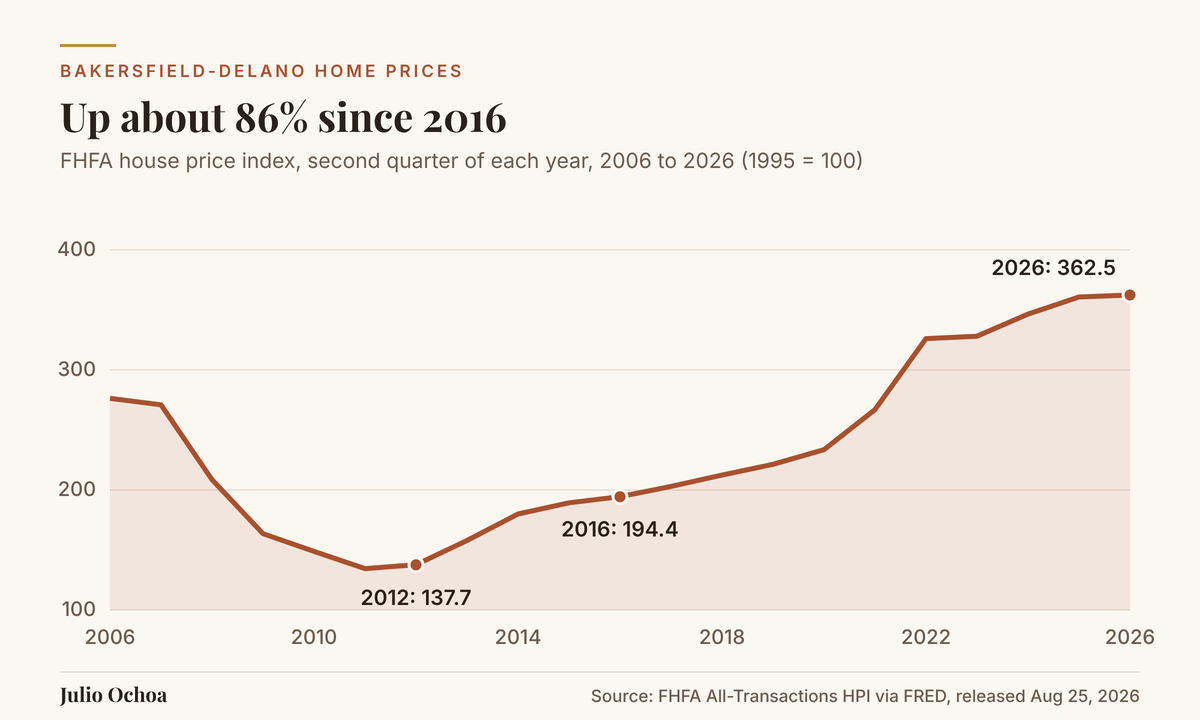
Here is what that index change looks like on a few example purchase prices. These are illustrations using the metro index, not appraisals. Your home's real number depends on its size, condition, upgrades and street.
| Bought in (Q2) | Example price paid | Same home at the 2026 index | Rough gain before costs |
|---|---|---|---|
| 2012 | $150,000 | About $395,000 | About $245,000 |
| 2016 | $220,000 | About $410,000 | About $190,000 |
| 2021 | $300,000 | About $407,000 | About $107,000 |
Source: FHFA All-Transactions House Price Index, Bakersfield-Delano MSA, Q2 2026 vs. Q2 of each year, released August 25, 2026.
In these examples the rough gain stays under the $250,000 single limit before selling costs and improvements come off, and the 2012 example is close to it. They are not a forecast for any one home, and your own numbers can land higher or lower. That is why the purchase papers and receipts matter.
What lowers your taxable gain?
These items can change the gain calculation, so it pays to track them down.
- Selling costs. Publication 523 counts sales commissions, advertising, legal fees and similar costs of the sale as selling expenses, and they come off the sale price. I broke those down in what it costs to sell a house in Bakersfield.
- Improvements. Publication 523 lists additions, a new roof, central air, a pool, fencing, landscaping, a sprinkler system and similar work as improvements that add to your basis. Repairs and upkeep, like painting or fixing a leak, do not count unless they were part of a bigger remodel.
- Some purchase costs. Certain closing costs from when you bought, like owner's title insurance, recording fees and transfer taxes, can be added to basis.
One local mix up worth clearing up. The assessed value on your Kern County property tax bill is not your basis. Under Prop 13 your assessed value generally starts from your purchase price and changes by its own rules, which you can read about in what you'll pay in Kern County property taxes, but your tax basis comes from your own purchase records and receipts.
When do Bakersfield sellers actually owe tax?
These are the situations I see where a seller should talk to a CPA before listing, not after.
The home was a rental or a second home
The exclusion is for your main home. A home that is a rental or vacation home when you sell usually does not qualify. A former rental you later moved into and lived in for at least two years may qualify, but Publication 523 limits the exclusion for time it was not your main home after 2008. And if you took depreciation on a rental or a home office, Publication 523 says the part of the gain equal to that depreciation cannot be excluded. If you own rentals, my post on buying a rental property in Bakersfield covers the numbers side.
You lived there less than two years
Sell before the 24 months and you may get only a partial exclusion, or none. Selling dates can change eligibility, so confirm the tax side with your CPA before we set a listing date.
The gain is over the limit
Long time owners, single owners and owners of higher priced homes are the most likely to cross $250,000 or $500,000. Generally only the amount over the limit is taxed, though depreciation and time it was not your main home can make more of it taxable.
You inherited the home
Here the news is usually good. Publication 523 says the basis of an inherited home is generally its fair market value on the date of death, not what the parent paid decades ago. In California, a community property state, a surviving spouse can also get a new basis on the whole home when the other spouse dies, if the IRS conditions are met.
How is the taxable part taxed?
| Level | How gain over the exclusion is taxed |
|---|---|
| Federal | Held more than a year, long-term rates of 0, 15 or 20 percent depending on taxable income (IRS Topic 409, updated September 24, 2026). Higher earners may also owe the net investment income tax. |
| California | No lower rate. The Franchise Tax Board says all capital gains are taxed as ordinary income (FTB page updated January 28, 2026). |
That California line is the one that surprises people moving here from other states. There is no separate capital gains rate. A taxable gain stacks on top of your other income for the year.
What is the California withholding at escrow?
California has its own step that happens at closing. Under the 2026 Form 593 instructions, escrow generally withholds 3 1/3 percent of the sale price and sends it to the Franchise Tax Board, unless the seller certifies an exemption. The common exemptions:
- The home was last used as your principal residence under the federal rule, without regard to the two year time period.
- The sale results in a loss or zero gain for California tax purposes.
- The sale price is $100,000 or less.
The principal residence exemption from withholding can apply even when you do not qualify for the full income tax exclusion. There is also an alternative calculation that applies a tax rate to your estimated gain instead of 3 1/3 percent of the full price. Your escrow officer will hand you Form 593 to complete. Read it, do not just sign it, because the certification is made under penalty of perjury. Withholding is a prepayment that counts toward your tax for the year, not an extra tax.
You may also receive a Form 1099-S for the sale. If you do, the IRS says you report the sale on your return even when the whole gain is excluded.
What should you do before you list?
- Find your closing statement from when you bought.
- Pull together receipts for improvements: roof, HVAC, solar you own, pool, additions, landscaping.
- Confirm your dates: when you bought, when you moved in, and any time it was rented.
- Get a realistic price range, so the gain estimate starts from a real number.
- Take those four things to a CPA or tax professional before the listing goes live.
If you are selling to buy again here, the order of moves matters too. I wrote about that in sell first or buy first in Bakersfield, and if you are 55 or older, Prop 19 in Kern County covers moving your property tax base. More seller questions are answered on my selling a home in Bakersfield page.
Common questions
Do I pay capital gains tax if I sell my house in Bakersfield?
Often not, if it is your main home and you owned and lived in it at least 2 of the last 5 years. You can exclude up to $250,000 of gain, or $500,000 married filing jointly. Gain above that is generally taxable, and depreciation you took is not excludable.
Does California tax capital gains on a home sale?
California follows the same main home exclusion. Gain above it is taxed by California as ordinary income, because the state has no lower capital gains rate.
Do I have to buy another home to avoid the tax?
No. Under the current rules in Publication 523, the exclusion depends on the ownership, use and look back tests, not on buying another home. You can sell, take the exclusion and rent, move away or buy later.
Why is escrow holding back money for the Franchise Tax Board?
California's real estate withholding is 3 1/3 percent of the sale price unless you certify an exemption on Form 593, such as the home being your principal residence. If withholding is taken, it is credited toward your California tax when you file.
Can I count my new roof or solar panels?
Improvements that add value or extend the home's life generally add to your basis, and Publication 523 lists a new roof, heating and cooling systems and similar work. Keep the receipts and let your CPA confirm the amount. If you took a tax credit for owned solar, Publication 523 says that credit comes back out of your basis. Leased solar is a different story, since you do not own the panels.
Is my Kern County assessed value my basis?
No. Your basis comes from what you paid plus qualifying costs and improvements. The assessed value on your tax bill is a separate number used for property tax.
Where to start
If you are thinking about selling, start with a real price range and your purchase paperwork, then sit down with your tax professional. I'm happy to put together the price range and walk you through what selling costs look like on your home, so your CPA has real numbers to work with. My seller guide covers the rest of the process step by step: Selling Your Bakersfield Home guide.
Sources: IRS Publication 523, California Franchise Tax Board, capital gains and losses, FTB 2026 Instructions for Form 593, IRS Topics 409 and 701, and the FHFA house price index via FRED. This post is general information, not tax or legal advice. Talk to a CPA or tax attorney about your situation.
Julio Ochoa | Next Level Realty | CalDRE 02198776 | 661-933-8428
Categories
Recent Posts