How Much Can a Landlord Raise Rent in Bakersfield in 2026?
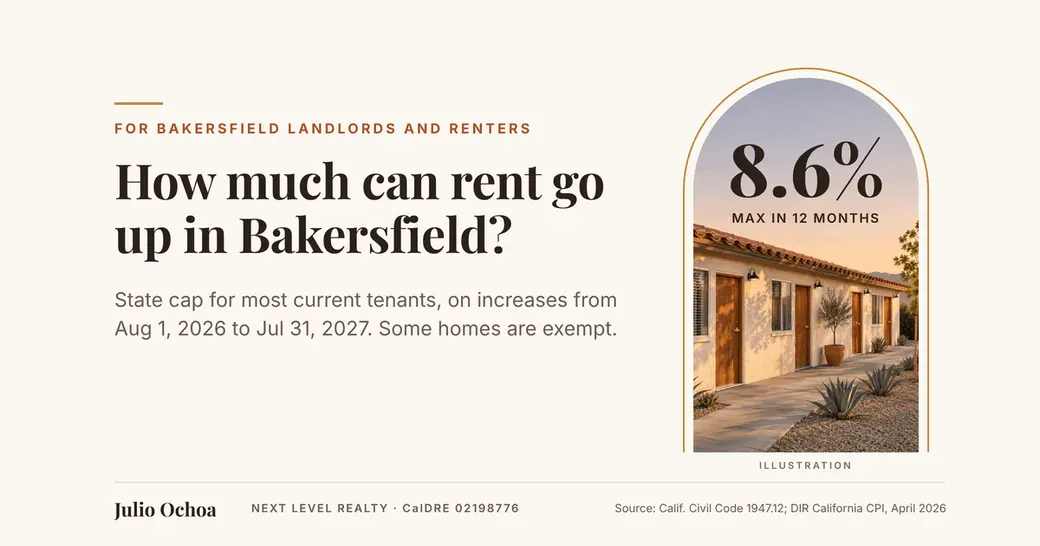
If a Bakersfield rental is covered by California's statewide rent cap, the landlord can raise a current tenant's rent by no more than 8.6 percent over 12 months for increases that take effect from August 1, 2026 through July 31, 2027. That number is 5 percent plus the change in the California Consumer Price Index, which was 3.6 percent from April 2025 to April 2026. Some homes are exempt, so check that first.
This is written for owners and buyers of rental property in Bakersfield and the rest of Kern County, and for renters who want to know where they stand. It is general information, not legal advice. For your own lease, talk to a landlord tenant attorney.
Where does the 8.6 percent come from?
The cap lives in California Civil Code Section 1947.12, the law most people call AB 1482. Over any 12 month period, an owner can't raise the rent by more than 5 percent plus the percentage change in the cost of living, or 10 percent, whichever is lower. The math runs off the lowest rent charged for that unit at any point in the 12 months before the increase.
The cost of living piece depends on where the property sits. Los Angeles, Orange, Riverside, San Bernardino, San Diego and five Bay Area counties use their own federal metro index. Kern County is not on that list, so the law sends Bakersfield to the California Consumer Price Index published by the state Department of Industrial Relations.
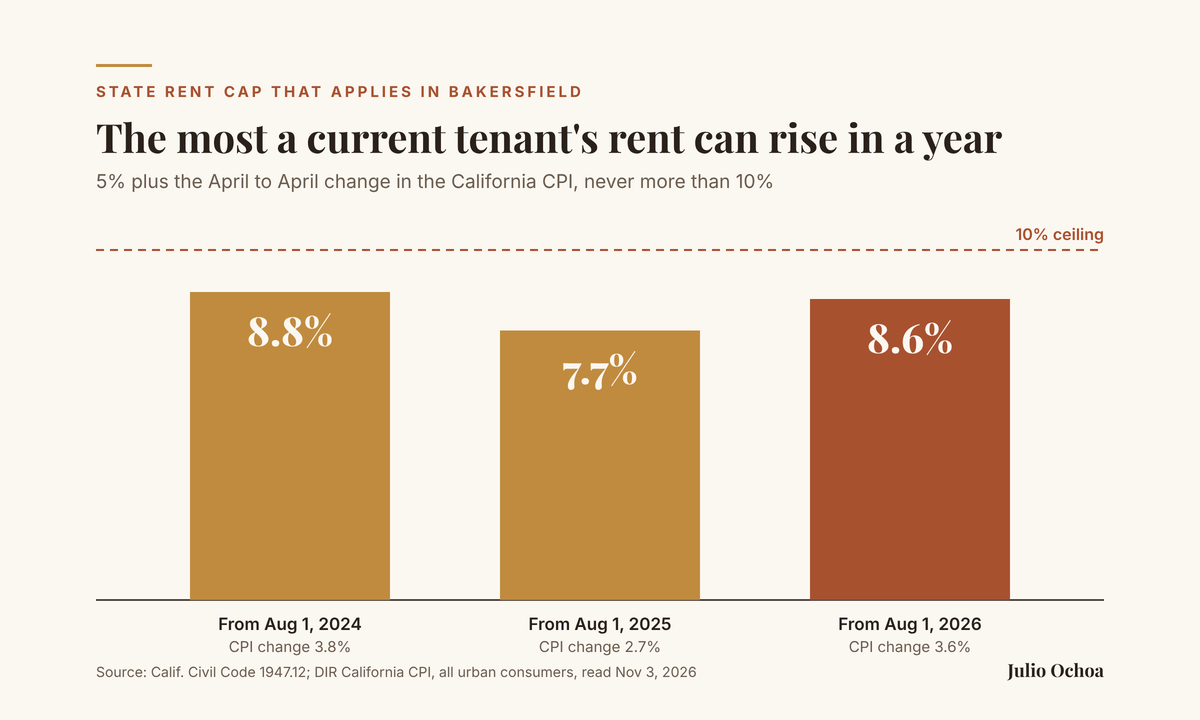
For increases that take effect on or after August 1, the law compares April of this year to April of last year and rounds to the nearest tenth. Here is what that produced, read from the DIR index table (updated October 15, 2026):
| Increases taking effect | California CPI change (April to April) | Cap in Bakersfield |
|---|---|---|
| Aug 1, 2024 to Jul 31, 2025 | 3.8% | 8.8% |
| Aug 1, 2025 to Jul 31, 2026 | 2.7% | 7.7% |
| Aug 1, 2026 to Jul 31, 2027 | 3.6% | 8.6% |
The index readings behind the current number: 364.746 in April 2026 and 352.063 in April 2025, all urban consumers, all items.
What does 8.6 percent look like in dollars?
The reported average asking rent per unit in Bakersfield's apartment market was $1,453 in the third quarter of 2026, according to the Lee and Associates Q3 2026 Bakersfield multifamily report. As an example only, 8.6 percent of $1,453 is about $125 a month, or about $1,578. A real increase is figured from that unit's own lowest rent in the past 12 months, minus any increase already taken in that window.
That is the ceiling, not a target. The same report shows vacancy at 6.0 percent in Q3 2026, up from 5.6 percent a year earlier, with 672 units under construction. When more units sit empty, pushing a good tenant to the legal maximum can cost you more in turnover than it earns.
Which Bakersfield rentals are covered?
Many rentals are covered, but it depends on the property and who owns it. These are the main exemptions in Section 1947.12(d), in plain words:
- Newer buildings. Housing that got its certificate of occupancy within the previous 15 years. This is a rolling window, so a building ages into the cap on its 15 year anniversary.
- A house or condo owned by a person, with the notice. A single family home or condo that can be sold separately is exempt only if the owner is not a real estate investment trust, a corporation, or an LLC with a corporation as a member, and the tenant got the exact written exemption notice the statute spells out. For a tenancy that started or renewed on or after July 1, 2020, that notice has to be in the lease. For older tenancies it could be given separately.
- An owner occupied duplex. Two units in one structure where the owner lived in one as a main home when the tenancy began and still does. An ADU or junior ADU does not count as the second unit here.
- Deed restricted affordable housing and school or college dorms.
- Units under a stricter local rent control law. I found no local rent control ordinance for the City of Bakersfield as of November 2026, so the state cap is the rule here. If your rental is in another Kern city, check with that city first.
| Your rental | Usually covered by the cap? |
|---|---|
| Apartment or fourplex more than 15 years old | Yes |
| House owned by an LLC with a corporate member | Yes |
| House or condo owned by you (not a corporation, REIT or LLC with a corporate member), exemption notice given | No |
| House owned by you, no notice given | Yes |
| Home finished within the last 15 years | No |
| Duplex where you lived in the other unit when the tenancy began and still do | No |
The notice is the step to double check. An owner of a single rental house can assume the house is exempt, never give the statement, and find the cap applies anyway.
What else does the law control?
- Two increases at most. If the same tenant stays, the rent can go up in no more than two steps over 12 months, and the total still can't pass the cap.
- Written notice. Under Civil Code 827, a month to month increase of 10 percent or less needs at least 30 days' written notice, plus extra days when the notice is mailed. Every capped increase falls in that group. A fixed term lease generally can't be raised before it ends unless the lease allows it.
- New tenant, new starting rent. When no one from the old tenancy stays, the owner can set the first rent for the new tenant freely. The cap applies to increases after that.
- Discounts don't reset the base. Move in specials and concessions are left out when finding the lowest rent, and they have to be listed separately in the lease.
- Just cause after 12 months. Under Civil Code 1946.2, once a tenant has lived there lawfully for 12 months, the owner needs a just cause, stated in the written notice, to end the tenancy. If another adult is added to the lease, the timing can stretch to 24 months. For a no fault reason, the owner either pays relocation help equal to one month's rent within 15 calendar days of the notice, or waives the final month's rent in writing.
Both sections are set to expire January 1, 2030, unless the Legislature extends them.
Why it matters if you're buying a rental
When you buy a rental with a tenant in place, you inherit the rent, not the market. A house rented $200 below market today can only rise up to 8.6 percent a year while that tenant stays, unless the house is exempt. That changes what the property is worth to you.
Before you write an offer on a tenant occupied home, I'd get:
- The current lease and every rent increase in the last 12 months
- Whether the lease carries the exemption notice, word for word
- The certificate of occupancy date, which the city or county can confirm
- How long the tenant has lived there, since the just cause rules start at 12 months
I walk through rents, yields and the costs out of town owners miss in what the numbers say on a Bakersfield rental. If you're thinking about adding a unit instead, read building an ADU in Bakersfield first.
The new construction angle
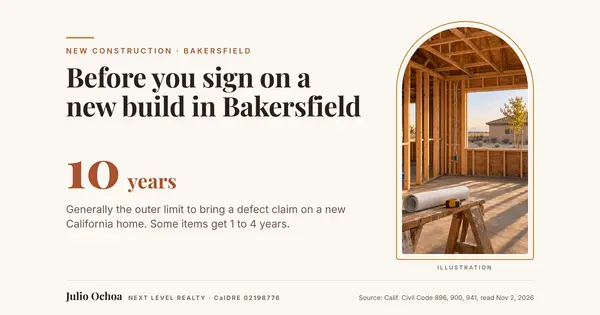
The 15 year exemption is why some investors look at newer homes. A home whose certificate of occupancy is less than 15 years old sits outside the cap until it ages in. Kern County has kept issuing single family permits every year, which I covered in new homes being built in Bakersfield. The just cause rules in Civil Code 1946.2 carry the same 15 year exemption. Both end on the anniversary, so plan for the day the home ages in.
If you rent in Bakersfield today
About 51,396 of the 133,186 occupied homes in the City of Bakersfield were renter occupied in 2024, roughly 39 percent, and the median gross rent was $1,708, according to the Census Bureau's 2024 American Community Survey one year estimates. If your rent keeps climbing toward the cap every year, it may be time to look at what owning would take. My rent or buy guide lays out the tradeoffs, and the first-time buyer questions page answers the ones I hear most.
Common questions
Does Bakersfield have rent control?
Bakersfield has no rent control ordinance of its own that I could find as of November 2026. Many rentals are covered by the state cap in Civil Code 1947.12 instead. Some homes are exempt, so check the list above.
How much can my landlord raise my rent in Bakersfield in 2026?
For increases that take effect from August 1, 2026 through July 31, 2027, the cap is 8.6 percent over 12 months, measured from the lowest rent in the prior 12 months. If your home is exempt, the cap doesn't apply.
Does the rent cap apply to a single family house?
It depends on who owns it and whether you got the exemption notice. A house owned by a corporation, a REIT, or an LLC with a corporate member is covered. A house owned by a person is exempt only if the required notice was given, and in a lease from July 1, 2020 on, it must be in the lease itself.
When will the cap change again?
The next number takes effect August 1, 2027, based on the California CPI change from April 2026 to April 2027. Check the DIR table once the April 2027 figure is out.
How much notice does a landlord have to give?
For a month to month tenancy, at least 30 days' written notice for an increase of 10 percent or less, which covers every capped increase. Longer notice is required for increases over 10 percent, which only an exempt home can take.
Can a landlord charge anything to a new tenant?
Generally yes, under the state cap. When no tenant from the prior tenancy remains, the owner sets the starting rent. The cap applies to increases after that.
Thinking about buying or selling a rental?
If you own a rental in Bakersfield and you're deciding whether to keep it, raise the rent or sell, or you're buying your first one, call me. We'll go through the lease, the exemption question and what similar rentals around it are getting, so the decision is based on real numbers. If you're renting now and want a plan to buy in the next year or two, start with my free buyer roadmap at yourbakersfieldbuyerplan.netlify.app. You can also read what my clients say on my reviews page.
The picture at the top of this post is an illustration, not a real property.
Julio Ochoa | Next Level Realty | CalDRE 02198776 | 661-933-8428
Categories
Recent Posts