Kern County Supplemental Tax Bill: A Buyer's Guide
Probably. If you bought a home in Kern County and your new value is higher than the seller's old assessed value, expect a supplemental tax bill on top of the regular one. It taxes that gap only for the months left in the tax year, and it is mailed to you, not your lender. Plan for it before it shows up.
I bring this up with every buyer I work with, because it is the bill that surprises people most in their first year. Here is how it works in Kern County, in plain words, with the real dates and the real formula.
What is a supplemental tax bill?
California reassesses a property when it changes ownership or when new construction is finished. Your annual tax bill is based on the value the Assessor set on January 1, which usually means the seller's old value. The supplemental bill covers the difference between that old value and your new one.
The Kern County Treasurer and Tax Collector says it plainly on its supplemental taxes page, read October 15, 2026: the supplemental bill is in addition to the annual bill, and both must be paid by their own delinquent dates.
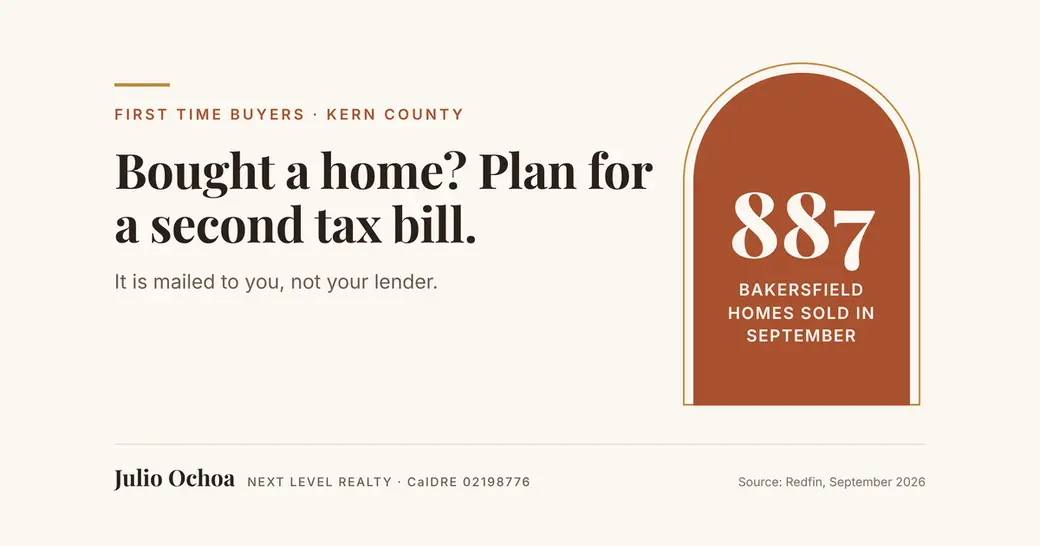
Sales happen every month here. Redfin counted 887 homes sold in Bakersfield in September 2026, at a median sale price of $419,800 for the three months ending September. Each of those sales is a change in ownership the Assessor has to review.
Why does the bill go to me and not my lender?
This is the part that catches people. The county mails the supplemental bill directly to the owner. Your lender does not receive it, even if your regular taxes are paid through an impound account.
The county's own page says it is your responsibility to ask your lender who will pay it. It also says the law does not let the Tax Collector remove penalties when a bill goes late because of a mix up between you and your lender. So the moment you close, ask your lender one question: "When the supplemental bill comes, do I pay it or do you?" Get the answer in writing.
How is the supplemental bill calculated?
Three pieces go into it.
- The difference in value. The Assessor sets the new value as of your purchase date, then subtracts the value already on the roll. That difference is the supplemental assessment.
- The tax rate. The county applies the tax rate for your area. Every California property starts at the 1% general levy, and voter approved bonds for your tax rate area are added on top. I explain that layer in what you will actually pay in Kern County property taxes.
- The months left in the tax year. The tax year runs July 1 to June 30. State law treats your purchase as happening on the first day of the following month, then multiplies the full year tax by a proration factor for the time remaining.
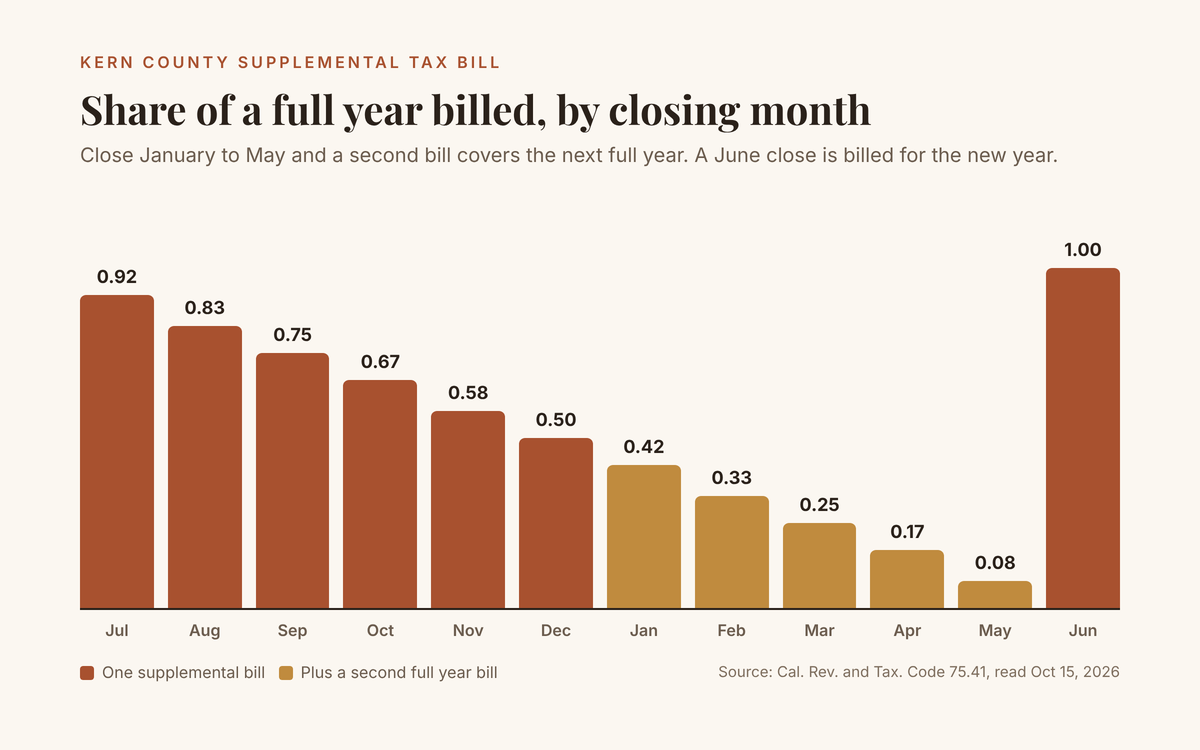
Those proration factors are written into California Revenue and Taxation Code section 75.41. Here is what they mean by the month you close.
| Month you close | Treated as | Share of a year billed | Supplemental bills |
|---|---|---|---|
| July | August 1 | 0.92 | One |
| August | September 1 | 0.83 | One |
| September | October 1 | 0.75 | One |
| October | November 1 | 0.67 | One |
| November | December 1 | 0.58 | One |
| December | January 1 | 0.50 | One |
| January | February 1 | 0.42, then 1.00 | Two |
| February | March 1 | 0.33, then 1.00 | Two |
| March | April 1 | 0.25, then 1.00 | Two |
| April | May 1 | 0.17, then 1.00 | Two |
| May | June 1 | 0.08, then 1.00 | Two |
| June | July 1 | 1.00 for the new tax year | One |
Why do some buyers get two supplemental bills?
It comes down to January 1, the lien date. When you close between January and May, the annual bill for the next tax year was already set on January 1, using the seller's old value. So the county sends a second supplemental bill covering the whole next tax year at the new value.
The county's page lays it out this way. Close between June 1 and December 31, and you get your share of the current annual bill, one supplemental bill for the rest of the year, and then a normal annual bill at your new value. Close between January 1 and May 31, and you get the first supplemental bill for the rest of the current year, plus a second supplemental bill for the full next year, alongside that year's annual bill.
Two supplemental bills can be normal when they cover two separate tax years. It is how the calendar works.
A worked example at the Bakersfield median price
Here is my own math, using only the 1% general levy so the arithmetic is easy to follow. Your actual tax rate may be higher once your area's voter approved bonds are added. Say you buy at $419,800, the Bakersfield median sale price Redfin reported for the three months ending September 2026, and the seller's assessed value on the roll was $250,000. That seller value is an example, not a real parcel.
- Supplemental assessment: $419,800 minus $250,000 equals $169,800.
- Full year tax at 1%: $1,698.
| You close in | Factor | Supplemental tax at 1% |
|---|---|---|
| September 2026 | 0.75 | $1,273.50 |
| December 2026 | 0.50 | $849.00 |
| March 2027 | 0.25, plus a full year bill | $424.50, then $1,698.00 |
These amounts are only the extra tax caused by the reassessment. They are not your whole property tax for the year, and the March example covers two separate tax years.
The bigger the gap between the seller's assessed value and your new value, the bigger this bill. A home that has not sold in a long time usually carries a low assessed value, so the gap is wide. New construction can also trigger supplemental assessments, because the county reassesses when construction is completed as well as when ownership changes. I cover new builds in new construction vs resale in Bakersfield.
When is the supplemental bill due?
It depends on the month the county mails it. The Kern County Treasurer and Tax Collector sets it out this way:
- Mailed July 1 through October 31: first installment delinquent December 10, second installment delinquent April 10. Same as the annual bill.
- Mailed November 1 through June 30: first installment delinquent on the last day of the month after the bill was mailed. Second installment delinquent on the last day of the fourth month after the first installment's delinquent date.
Both installments are delinquent at 5 p.m. on their dates. A late installment gets a 10% penalty, and a late second installment also gets a $10 cost. For this year's annual bill, the county's important dates page shows the first installment due November 1 and delinquent December 10, and the second due February 1 and delinquent April 10.
There is no fixed arrival date for a supplemental bill. The county's own page warns that someone who buys and resells within a few months may not see their supplemental bill until after they have sold. Watch your mail for months after closing, and keep it with your closing papers.
Can I lower my supplemental bill?
Two things are worth checking.
The homeowners' exemption. If the home is your main residence, the State Board of Equalization's homeowners' exemption page says it takes $7,000 off the taxable value. It is a one time filing with the county Assessor, and a first time filer should file no later than February 15 to receive the full exemption for that year. At the 1% levy, $7,000 is about $70 a year. The Kern County page notes the exemption can apply to a supplemental bill too, and state law (Revenue and Taxation Code section 75.22) ties that to qualifying within 90 days of your purchase. Claim deadlines for a supplemental bill can differ from the February 15 date, so file as soon as you move in and ask the Assessor which deadline applies to your notice.
An appeal. If you believe the new value is wrong, talk with the Assessor's office first at 661-868-3485. A formal appeal of a supplemental assessment must be filed within 60 days of the date on the Notice of Supplemental Assessment, with the Clerk of the Board of Supervisors at 1115 Truxtun Ave in Bakersfield. Ask the Clerk about the current filing fee before you file. Regular annual appeals have a different window, July 2 through November 30.
If the reassessment lowers the value instead, the county says a refund is issued by the Auditor Controller. That does not reduce the annual bill, which still has to be paid as billed.
What should I do right after closing?
- Ask your lender in writing who pays the supplemental bill.
- Estimate it with my example math above, or with the estimator on the Kern County Treasurer and Tax Collector website.
- Set the money aside. Do not assume your closing funds covered it; ask your lender or escrow. I break down what is in those numbers in closing costs in Bakersfield.
- File for the homeowners' exemption if the home is your main residence.
- Read your Notice of Supplemental Assessment the day it arrives. The 60 day appeal clock starts on its date.
- If you are in the city of Bakersfield, remember your tax bill also carries city charges like the sewer fee. I wrote about that in Bakersfield's sewer fee increase.
Buying your first home and still sorting out all the costs? I answer the questions people ask me most on my first time buyer questions page.
Common questions
Do I have to pay the supplemental tax bill if my lender has an impound account?
The bill comes to you either way. Kern County mails it to the owner, and your lender does not receive it. Ask your lender whether they will pay it from the impound account or whether you pay it. The county cannot excuse penalties caused by a mix up between you and your lender.
Will I still get a regular tax bill in November?
Yes. The supplemental bill is in addition to the annual bill. In your first year you may be paying your share of an annual bill based on the seller's old value, plus the supplemental bill for the difference.
Why did I get two supplemental bills?
If you closed between January and May, the next year's annual bill was already set on January 1 at the old value. The county sends a second supplemental bill to cover that full year at your new value.
Does the seller pay any of the supplemental tax?
The supplemental tax covers the new value from the first day of the month after your purchase, so it belongs to the new owner. How the regular annual bill is split between buyer and seller is set by your purchase contract and escrow instructions.
Can I appeal a supplemental assessment?
Yes. Talk with the Kern County Assessor first. The county says a formal appeal of a supplemental assessment must be filed within 60 days of the date of the Supplemental Assessment Notice.
Does Prop 19 or a family transfer change this?
Some transfers, like certain parent and child transfers, may not trigger reassessment, but they require a filing within a limited time. If you are moving your tax base under Prop 19, read Prop 19 in Kern County and confirm the details with the Assessor.
Plan for the bill before it shows up
A supplemental bill is not a penalty. It reflects a change in assessed value, and it is part of buying a home in California, and it is easy to handle when you know it is coming. When you buy with me, we talk about this before you sign anything, so you know what to expect and how to prepare. If you want a plain list of every cost from offer to keys, my first time buyer guide walks through it: get the first time buyer guide here. Or call me and ask anything, even the random stuff.
This is general information, not tax or legal advice. Your exact bill depends on your property, your tax rate area and the Assessor's value. Confirm with the Kern County Assessor, the Treasurer and Tax Collector, or a tax professional.
Sources: Kern County Treasurer and Tax Collector, Supplemental Taxes and Important Dates pages, read October 15, 2026. California Revenue and Taxation Code sections 75.41 and 75.22, read October 15, 2026. California State Board of Equalization, Homeowners' Exemption page, read October 15, 2026. Redfin Bakersfield housing market page, data through September 2026, read October 15, 2026.
Julio Ochoa | Next Level Realty | CalDRE 02198776 | 661-933-8428
Categories
Recent Posts